

SHARE THIS ARTICLE
BLOG
Measuring H₂S at the Wellhead with Portable Gas Analysis for Well Services
29 Oct 2026
Hydrogen sulphide (H₂S) is one of the more difficult hazards to manage at a well site. It can affect personnel safety, accelerate equipment degradation and influence whether produced gas can be routed to sales.
For well test, intervention, clean-up and flowback crews, the practical questions are rarely simply “Is H₂S present?” They are more often:
- How much H₂S is in the stream?
- How quickly is it changing?
- What else is present alongside it?
- Can the data be trusted at the pressures, flow rates and fluid conditions actually seen at the wellhead?
SMS has worked with operators, well service companies and well test contractors on these questions for many years. This article looks at the monitoring challenges involved in sour service, and the engineering considerations behind it.
What Clients Usually Need to Know
Requests for portable H₂S and gas analysis tend to fall into a few recurring themes.
Personnel safety comes first. H₂S exposure limits leave little room for error. In the UK, HSE’s EH40/2005 sets an 8-hour time-weighted average of 5 ppm and a 15-minute short-term exposure limit of 10 ppm. Wells can flow at concentrations far above these levels, so crews need early and reliable warning, not only a reading after the gas has already reached the work area.
Manual sampling can be slow and exposes people unnecessarily. Detector tubes and spot samples still have a role, but they provide one result at one moment. Sampling may also require personnel to handle and vent gas at the point of measurement. Several clients have asked for repeatable, near-real-time readings with less routine venting and reduced manual handling.
Sales-gas decisions need low-level accuracy. After a well treatment, operators often need to confirm when H₂S has fallen below a release or pipeline specification. Common pipeline sulphur limits are around 0.25 grains per 100 scf, equivalent to approximately 4 ppm. At that point, the measurement needs to be credible in single-digit ppm, not only at high alarm levels.
Sour service classification depends on more than concentration. Materials selection, inhibitor programmes and flowline design can all change depending on the H₂S level and operating pressure. A single high or low reading can influence the design case for the completion, flowline or surface equipment.
Trends matter during clean-up and flowback. H₂S can rise, fall or appear unexpectedly during flowback after stimulation, clean-up operations or well testing. Clients often want to see how H₂S behaves against time, choke setting and flow rate, rather than relying on isolated readings.
H₂S is often only part of the gas picture. For sour and acid-gas wells, CO₂ and the hydrocarbon profile are also important. These measurements support reservoir evaluation, gas quality assessment, flare and fuel-gas decisions, and calculations for sour service.
Equipment needs to work in the field. Well service operations move between locations, sometimes for only a few hours per well. Monitoring equipment must be portable, suitable for hazardous areas, quick to connect and robust enough for wet, dirty and high-pressure gas.
Sour Service Is Defined by Partial Pressure
A point that often changes the conversation with clients is that sour service is not determined by H₂S concentration alone. Under ISO 15156-2 / NACE MR0175, carbon and low-alloy steels must be selected for resistance to sulphide stress cracking when the H₂S partial pressure in the gas phase is 0.3 kPa (0.05 psi) or higher.
H₂S partial pressure is calculated as:
H₂S partial pressure = Total absolute pressure x H₂S mole fraction
This means that a relatively low H₂S concentration can still create a sour service condition if the system pressure is high.
| Absolute pressure | Approximate H₂S concentration at 0.3 kPa partial pressure |
| 10 bar (1,000 kPa) | Around 300 ppm |
| 100 bar (10,000 kPa) | Around 30 ppm |
| 345 bar (34,500 kPa / approx. 5,000 psi) | Around 9 ppm |
On a high-pressure well, single-digit ppm H₂S can therefore be enough to bring the system into sour service. Accurate low-level measurement is not only relevant for safety and gas quality. It can also support materials and corrosion decisions.
Severe Sour Service Adds Further Complexity
ISO 15156 also considers environmental severity, including H₂S partial pressure and in-situ pH. The most severe conditions are associated with high H₂S partial pressures and low pH. The standard also highlights the importance of considering low-pH condensed water during shutdowns or process upsets, as well as exposure to stimulation acid returns.
These are exactly the conditions that can occur during clean-up and post-acid flowback.
Sample Conditioning Determines Data Quality
Even a well-specified analyser will only perform as well as the sample it receives.
At the wellhead, gas may arrive at high pressure and be saturated with water. It may also contain condensate, solids, acid returns, completion fluids or rapidly changing flow conditions. A poorly designed sample system can cause H₂S to be absorbed or react before it reaches the analyser, allow liquids into the measurement chamber, or introduce lag that masks real changes in the well.
SMS analysers include built-in sample conditioning that filters, pressure-regulates and flow-controls the sample before it enters the measurement chamber. For well service work, the sample system is designed around the specific application.
Typical considerations include:
- Staged pressure reduction from wellhead or separator pressure to analyser conditions.
- Heated first-stage regulation where expansion cooling could cause freezing or hydrate formation in wet gas.
- Overpressure protection downstream of each regulation stage, routed to a safe destination.
- Staged liquid and particulate removal, including knock-out, coalescing and membrane filtration.
- Inert-coated wetted flow paths for low-ppm measurement, since uncoated stainless-steel components can adsorb H₂S and cause low or delayed readings.
- Short, small-bore sample paths with bypass loops to reduce lag time.
- Dilution for high-range H₂S measurement.
- Closed return or scrubbed venting wherever practical, in line with site hazardous-area and HSE requirements.
Application Focus: Post-Treatment H₂S Monitoring
A recent enquiry from a US shale gas operator illustrates how these requirements come together in practice.
The operator treats producing gas wells to remove iron sulfide. After treatment, they need to monitor H₂S in the produced gas and confirm when the well meets their release criteria, so that gas can be sent to sales below the allowable limit.
Their existing method used detector tubes. This meant manual sampling, venting gas during each test, and potential H₂S exposure when handling the tubes.
Why the Application Is Demanding
The measurement span is wide. The system needs to track H₂S down from hundreds of ppm after treatment, then provide an accurate reading at single-digit ppm near the release limit. A single standard range rarely handles both ends of that requirement well, so the range configuration needs to be aligned with the release limit.
The pressure range is also wide. A 60:1 variation in wellhead pressure requires staged regulation and relief protection to ensure the analyser receives stable sample conditions.
The gas is wet and contains solids. Produced water and iron sulfide particles can plug filters and sample lines. Iron sulfide deposited on surfaces can also absorb H₂S, causing readings to read low.
Filter handling introduces another hazard. Iron sulfide collected in filters can become pyrophoric when exposed to air, so filter changeouts need a defined and controlled procedure.
Closed sample return is preferred. Lead acetate measurement takes place at near-atmospheric pressure, so return options depend on a suitable low-pressure destination on site, such as a flare, vent header or vapour recovery system. Where none is available, the analyser exhaust can be scrubbed.
The Proposed Approach
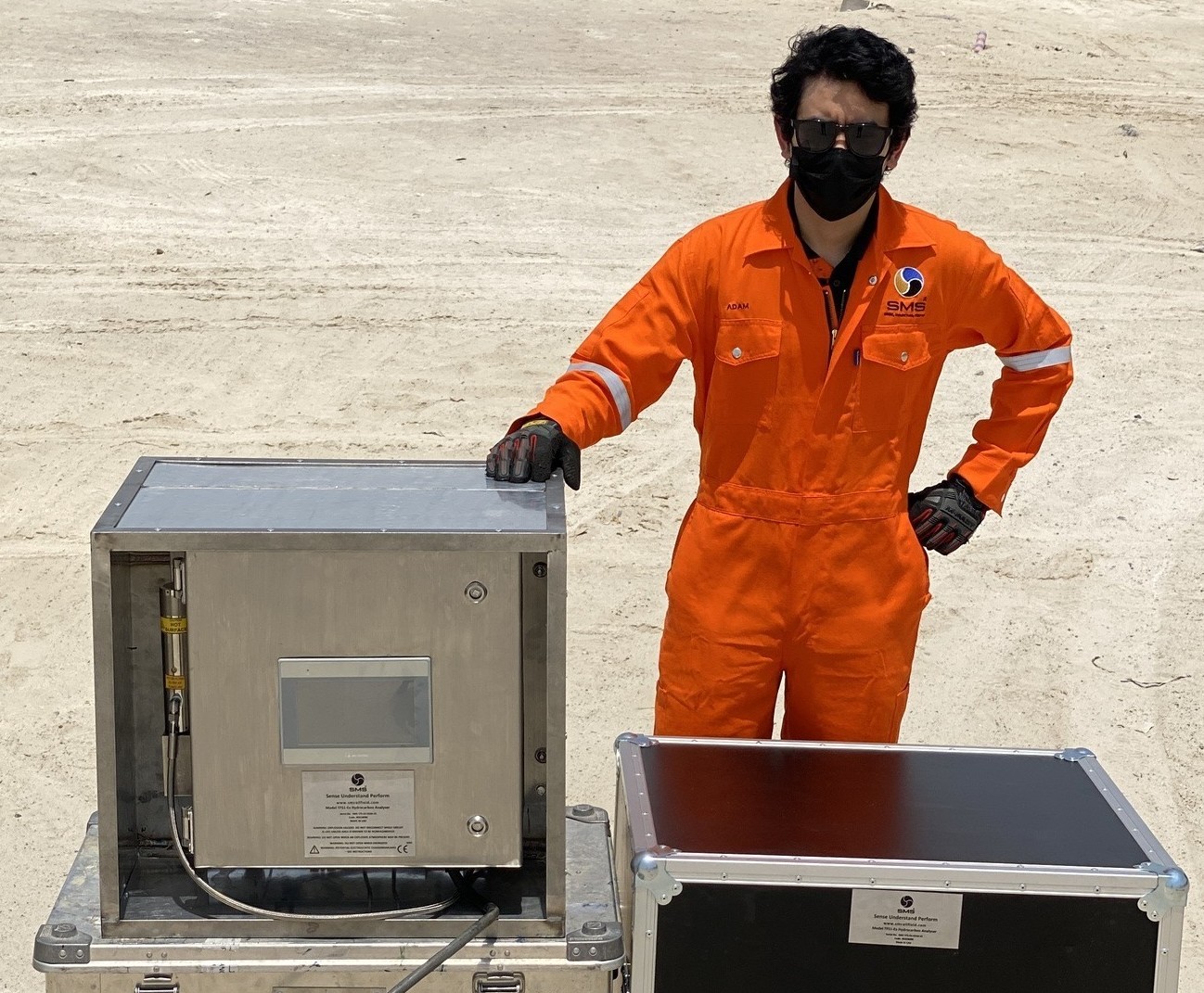
For this type of deployment, the proposed set up would use the lead acetate Real-Time H₂S Analyser within a self-contained portable system with:
- NPT adaptor kit for ¼-inch to 2-inch connections.
- Liquid and solids removal at pressure.
- Heated two-stage regulation with relief protection at each stage.
- Staged quick-change filtration with plugging indication.
- Inert-coated flow path.
- Bypass loop for faster response.
- Closed-return or scrubbed-vent manifold.
- Local display.
Alongside the equipment, a bump check was recommended using certified H₂S gas close to the release limit at the start of each deployment, winterisation for cold-weather operation, and a side-by-side field trial against the operator’s existing detector-tube method.
For post-treatment release decisions, the value is not simply replacing detector tubes. It is obtaining a repeatable, near-real-time reading at the ppm level that matters, with less venting and reduced exposure for the crew. Achieving that depends as much on the sample system as on the analyser itself.
Designed Around Field Realities
The gas analyser packages are built around the practical demands of well service operations:
- Portable and quick to rig up, with small-bore connections for temporary installation on process pipework.
- Hazardous area rated for onshore well sites, central processing facilities and offshore environments.
- Automated, with minimal maintenance requirements. The H₂S system requires monthly visual checks and three-monthly calibration checks.
- Connected, with live data available to client acquisition systems and SMS SMART software for reporting.
- Supported by experienced field technicians during installation and commissioning, with on-site and remote assistance, plus training and rental options where required.


